



Almost 80% of the inhabitants of our country suffer from lumbar osteochondrosis, but only half of them seek medical help.The main symptom of the disease is pain in the back and lower back, which can radiate to the lower extremities.
Lumbar osteochondrosis occurs equally often in both women and men.Among the patients, people over 30 years predominate.
What is lumbar osteochondrosis?
Osteochondrosis of the lumbar spine (lumbar osteochondrosis) is a degenerative-dystrophic lesion of the vertebrae and intervertebral discs, which has a long-term chronic course and can be complicated by intervertebral hernias, inflammation of the sciatic nerve and cauda equina syndrome.

Osteochondrosis of the spine most often affects the lumbar region, because it bears the greatest load during movements, physical labor or sedentary work.
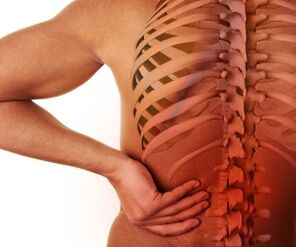
The lumbar region is located between the thoracic and sacral spine.It is formed by five massive vertebrae connected by intervertebral discs.
The intervertebral disc is disc-shaped and made of cartilage tissue.In the center of the disc there is a pulpal nucleus surrounded by a fibrous ring.
Intervertebral discs are the “shock absorbers” of the body, thanks to them the spine remains flexible and mobile.
Osteochondrosis leads to disruption of microcirculation and metabolism in the intervertebral discs, so they become less elastic.
Degenerative-dystrophic processes of the spine lead to drying out of the intervertebral discs and a decrease in their height.
Important!Over time, the load on the fibrous ring increases and it ruptures, the roots of the spinal nerves become pinched, resulting in pain.
Untimely treatment of lumbar osteochondrosis leads to impaired mobility of the spine and disability of the patient.
What leads to the appearance of lumbar osteochondrosis?

It is impossible to identify one specific cause of lumbar osteochondrosis.
There are several theories about the occurrence of this disease:
- Lumbar osteochondrosis occurs due to prolonged overstrain of the muscles of the lumbar girdle or their hypotension.As a result, the load on the spine increases, microcirculation is disrupted and degenerative-dystrophic changes appear in the bone and cartilage tissue of the vertebrae and intervertebral discs;
- the endocrine theory implies the occurrence of osteochondrosis against the background of disruption of the endocrine glands;
- metabolic theory – metabolic disorders, especially calcium;
- hereditary theory – genetic predisposition to lumbar osteochondrosis;
- the autoimmune theory is the destruction of the bone and cartilage tissue of the spine by one’s own immune system;
- theory of systematic microtraumas.
Factors that lead to degenerative-dystrophic changes in the lumbar spine may be:

- physical inactivity and a sedentary, predominantly sedentary lifestyle (office workers, drivers, programmers, cashiers);
- staying in one position for a long time (needlewomen, waiters);
- pathology of endocrine organs;
- heart and vascular diseases;
- diseases of the digestive system;
- heavy physical labor (loaders, builders);
- improper lifting of weights and exercises during sports;
- autoimmune and inflammatory joint diseases;
- congenital anomalies of the spine;
- flat feet and club feet;
- mechanical back injuries;
- metabolic pathology;
- physiological aging of the body;
- improperly formed posture in childhood;
- overweight and obesity;
- poor and unhealthy diet;
- genetic predisposition;
- sleeping in a hammock, on a water or air mattress, or a cot;
- chronic stress;
- frequent hypothermia of the lower back.
Pathogenetic classification of lumbar osteochondrosis
The course of lumbar osteochondrosis can be divided into the following stages:
- the stage of dystrophic changes in the intervertebral discs of cartilage, which is characterized by narrowing of the intervertebral space;
- the spondylosis stage is characterized by damage to several vertebrae of the lumbar spine;
- stage of spondyloarthrosis - the process spreads to the intervertebral joints, which significantly reduces the mobility of the lumbar spine.
How does lumbar osteochondrosis manifest?
Interesting!The manifestations of lumbar osteochondrosis are varied and it is often perceived as a disease of the abdominal organs.
Therefore, it is necessary to conduct a thorough examination of the body to exclude life-threatening conditions (acute appendicitis, acute pancreatitis, acute cholecystitis and others).
The following main signs of the disease can be identified:
- aching pain in the lower back, which increases with sudden movements and prolonged sitting.The pain is relieved by lying down;
- unilateral stabbing pain in the gluteal muscles, which intensifies after movements, coughing, sneezing, intense laughter.Relief comes from a horizontal position on the healthy side or a knee-elbow position with a pillow under the stomach;
- a feeling of painful lumbago in the lower back that appears suddenly when lifting heavy objects or sharply bending the body forward or backward.An exacerbation may bother the patient for several days.To reduce pain, the patient is in a forced lying position;
- reduction in the volume of one of the buttocks;
- impaired sensitivity of the skin of the lower back and buttocks (numbness, tingling, burning);
- dryness and discoloration of the skin (blue discoloration) of the lower back and buttocks;
- hypofunction of the sweat glands of the lower back and buttocks;
- dysfunction of the genitourinary system (dysuria, enuresis, impotence).
Diagnosis of lumbar osteochondrosis
The patient should carefully collect complaints, anamnesis of illness and life.Clinical syndromes characteristic of lumbar osteochondrosis are of great diagnostic value, including the following:
- Vertebral syndrome consists of the following symptoms:
- the appearance of pathological curves of the spinal column or strengthening and flattening of physiological curves (increased lordosis, scoliosis or lordoscoliosis);
- stiffness of the lumbar spine through spasm of the paravertebral muscles;
- pain in the lumbar spine, which can radiate to the buttock or lower limb;
- pain on palpation of paravertebral points.
- Reflex syndrome occurs due to pinching of the spinal nerve roots of the lumbar spine and is a combination of the following symptoms:
- intense pain in the lumbar region and in areas that innervate pinched nerves;
- “lumbago” in the lumbar region, which brings a lot of suffering to patients;
- impaired sensitivity and paresthesia of areas of innervation by damaged nerves (numbness, tingling, goosebumps, burning);
- impaired mobility of the lumbar spine;
- Compression syndrome is a clinical manifestation of compression, pinching of the nerve roots of the spinal nerves and spinal cord vessels in the intervertebral foramina.Nerves and vessels can be compressed by protrusion of intervertebral discs, osteophytes (bone growths), herniated intervertebral discs (Schmorl's hernia):
- paresis and paralysis of the lower extremities;
- dysfunctions of the genitourinary system;
- chronic discirculatory myelopathy;
- cauda equina compression.
It is not always possible to make a diagnosis based on just one patient complaint, so the examination algorithm must necessarily include additional instrumental diagnostic methods:
- X-ray of the lumbar spine in frontal and lateral projections.On x-rays you can clearly see the narrowing of the intervertebral spaces and foramina, Schmorl's hernias, the presence of osteophytes (bone growths);
- magnetic resonance imaging of the lumbar spinal column, which allows you to accurately determine the localization and extent of the process, compression of the spinal cord and blood vessels, displacement of intervertebral discs and their hernias;
- Computed tomography is performed for the same purpose as magnetic resonance imaging.With the help of computed tomography, soft tissue components (muscles, blood vessels, spinal cord) are perfectly visualized.
Treatment of lumbar osteochondrosis
Important!Osteochondrosis of the lumbar spine is an incurable disease.
In what ways and how to treat osteochondrosis?Using conservative and non-conservative methods, you can only relieve pain, slow down the development of degenerative processes and prevent complications.The sooner treatment is started, the greater the chances of staying on the move and avoiding disability.
Treatment algorithm for lumbar osteochondrosis:
- Conservative methods:
- drug therapy;
- physical therapy;
- massage and self-massage;
- manual therapy;
- acupuncture;
- physiotherapy.
- Surgical treatment.
Drug treatment
The main goal of drug therapy is to relieve pain and inflammation in the spine and lower back.For this purpose, the following groups of drugs are prescribed:

- Nonsteroidal anti-inflammatory drugs have anti-inflammatory and analgesic effects.To eliminate the negative effect of drugs of this group on the gastric mucosa, they are combined with proton pump inhibitors;
- muscle relaxants relieve spasm of the paravertebral muscles, thereby reducing pain and increasing the mobility of the spine.These drugs can affect the respiratory muscles, so they are prescribed under the supervision of a doctor.
- chondroprotectors, which contain components of cartilage tissue, restore and protect the intervertebral discs and joints of the spine from negative factors;
- glucocorticosteroids are administered paravertebrally.Thanks to glucocorticosteroids, a long-term anti-inflammatory effect occurs;
- vitamin therapy.A special place in the treatment of lumbar osteochondrosis is given to B vitamins (B1, B6, B12);
- local therapy.
Therapeutic exercise
Therapeutic exercise and gymnastics are carried out to reduce pain and eliminate muscle spasms.
Interesting!During the period of exacerbation of the process, relief comes from a forced position on the back with a small pillow under the head and bent legs at the hip and knee joints.You need to lie on a hard surface.
When the condition improves, you can begin performing exercises with static and dynamic loads on different muscle groups of the back, torso, and lower extremities.During exercise therapy for osteochondrosis of the lumbar region, you need to breathe freely, do not hold your breath.
During the period of remission, spinal traction can be performed, which allows you to release the roots of the spinal nerves.
Manual therapy
Manual therapy is a manual dosed effect on muscles and vertebrae, aimed at correcting pathological processes in the spinal column.
With the help of manual therapy, you can treat the spine and restore the normal position of the vertebrae and intervertebral discs.
Important!To avoid spinal injury, manual therapy should only be performed by a qualified and experienced chiropractor.
Acupuncture
The acupuncture method involves applying thin needles to the active points, as a result of which internal opiates and cortisol enter the blood, which have an anti-inflammatory and analgesic effect.
Massage and self-massage
Massage uses techniques such as stroking, rubbing and kneading the muscles of the back, collar area, pelvic muscles and lower extremities.
Physiotherapy

Physiotherapeutic methods include the following:
- electrophoresis;
- vibration massage;
- magnetic therapy;
- balneotherapy
- ultrasound therapy;
- mud therapy;
- treatment with ultraviolet irradiation.
The decision on surgical intervention is made last.
But in the presence of persistent pain syndrome, which can be relieved with medication for three months, as well as in cases of cauda equina compression syndrome, dysfunction of the pelvic organs and progressive paresis of the foot, surgery is mandatory.
Lumbar osteochondrosis should be taken seriously.Treatment should be carried out only by qualified specialists, such as a neurologist, physiotherapist, physical therapy doctor, chiropractor and others.
Self-medication for lumbar osteochondrosis can be not only useless, but also dangerous to your health.